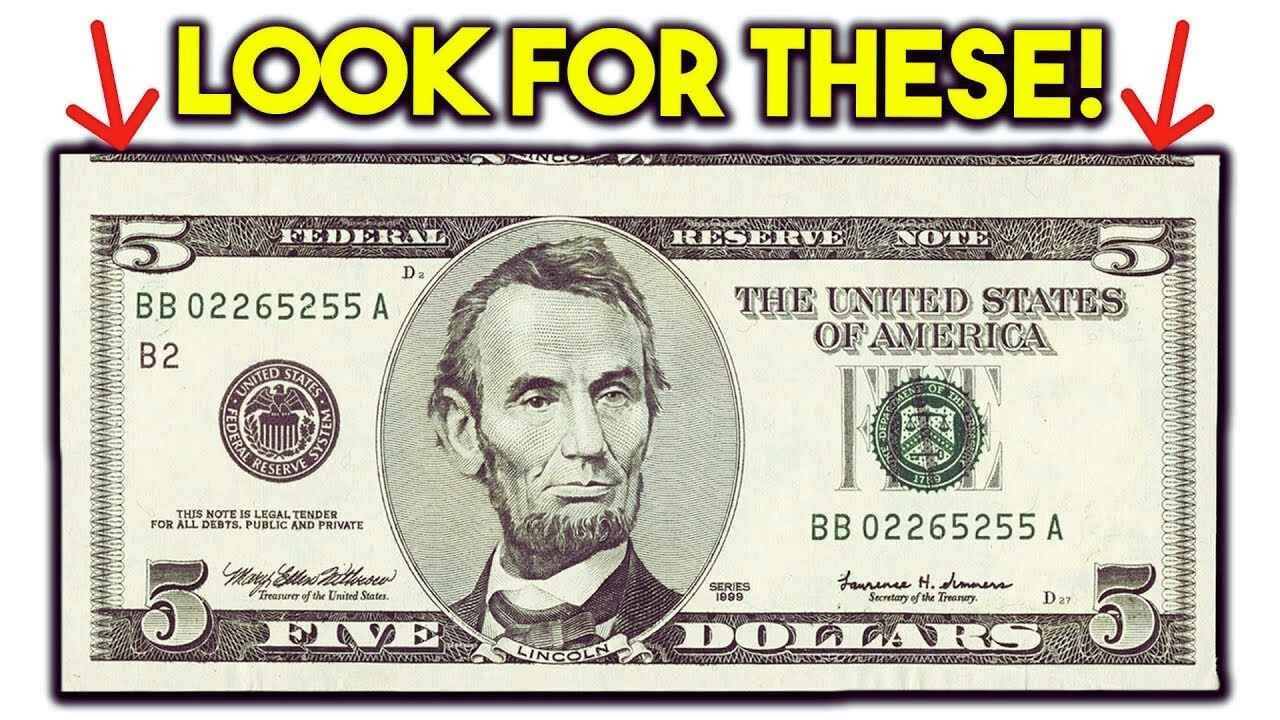
If you’ve ever pulled a $5 bill out of your wallet and noticed something looks a little off, you might be holding one of the rarest modern U.S. currency errors – the famous 1995 Series $5 bill with an upside-down Treasury seal (and sometimes the serial numbers too). These misprints happened because of a feeding mistake at the Bureau of Engraving and Printing, and only a tiny number slipped into circulation. Some of these bills have sold for thousands of dollars. Here’s exactly how to spot one in your own cash.
What Makes the 1995 Upside-Down Seal $5 Bill So Special?
In 1995, the BEP was printing the new Series 1995 $5 notes featuring a larger, off-center portrait of Abraham Lincoln. During the third printing (the overprint stage where the green Treasury seal, Federal Reserve seal, and serial numbers are added), a sheet of 32 bills was accidentally fed into the press upside-down and backwards. The black front overprint ended up 180 degrees rotated compared to the green back and the rest of the note.
Only about 3-4 sheets (roughly 96–128 bills) are believed to have this dramatic error, making it one of the scarcest modern U.S. errors.
Step-by-Step: How to Check Your 1995 $5 Bill
Look at the series year
Flip the bill to the Lincoln side and check the bottom right near the portrait. It must say “Series 1995.” Earlier or later years (1993, 1999, 2001, etc.) do not have this error.
Check the Treasury seal orientation (the easiest giveaway)
Hold the bill with Lincoln facing you and right-side up.
- On a normal $5 bill, the green Treasury seal (the one that says “THE DEPARTMENT OF THE TREASURY 1789”) is to the right of Lincoln and reads correctly when the bill is upright.
- On the error bill, that same green seal is upside-down and appears on the left side of Lincoln instead of the right.
Look at the Federal Reserve seal and serial numbers
- Normal bill: Black Federal Reserve seal and both serial numbers are right-side up.
- Error bill: The black seal and both serial numbers are printed upside-down and shifted to the opposite side of the note.
Check the back of the bill
The back of the bill is printed normally (Lincoln Memorial right-side up). When you flip the error note over, the front now looks “upside-down” compared to the back, which is the dead giveaway.
Quick visual bullet checklist
- Green Treasury seal upside-down and on the left of Lincoln
- Black seals and serial numbers upside-down and on the right of Lincoln
- Back of the bill is completely normal
Grades and Recent Sale Prices
Because so few exist, condition matters a lot:
- Crisp Uncirculated (CU) examples have sold for $8,000–$15,000+
- Extremely Fine to About Uncirculated bring $3,000–$7,000
- Even heavily circulated examples still fetch $800–$2,000
The current record is around $18,000 for a gem note from the famous “Fort Worth” discovery batch.
Conclusion
Next time you get change at the store or empty your pockets, take five seconds to glance at any 1995 $5 bills. The upside-down green Treasury seal is impossible to miss once you know what you’re looking for. While the odds are tiny, people still find these in circulation even today one was discovered in a fast-food cash register as recently as 2023. It literally pays to check your money
FAQs About the 1995 Upside-Down $5 Error
Q: Are all upside-down seal 1995 $5 bills valuable?
A: Yes, every confirmed example is from that one printing mistake. There are no “common” versions.
Q: What if only the serial numbers are upside-down but the seal is normal?
A: That’s a different, much less dramatic error and worth only $50–$150.
Q: Do I need to send it to PMG or PCGS to get it graded?
A: For top dollar, yes. Buyers pay the most for notes slabbed and authenticated by a major grading service.
Q: Where is the best place to sell one if I find it?
A: Reputable auction houses like Heritage Auctions, Stack’s Bowers, or Lyn Knight regularly handle these errors and get the strongest prices.